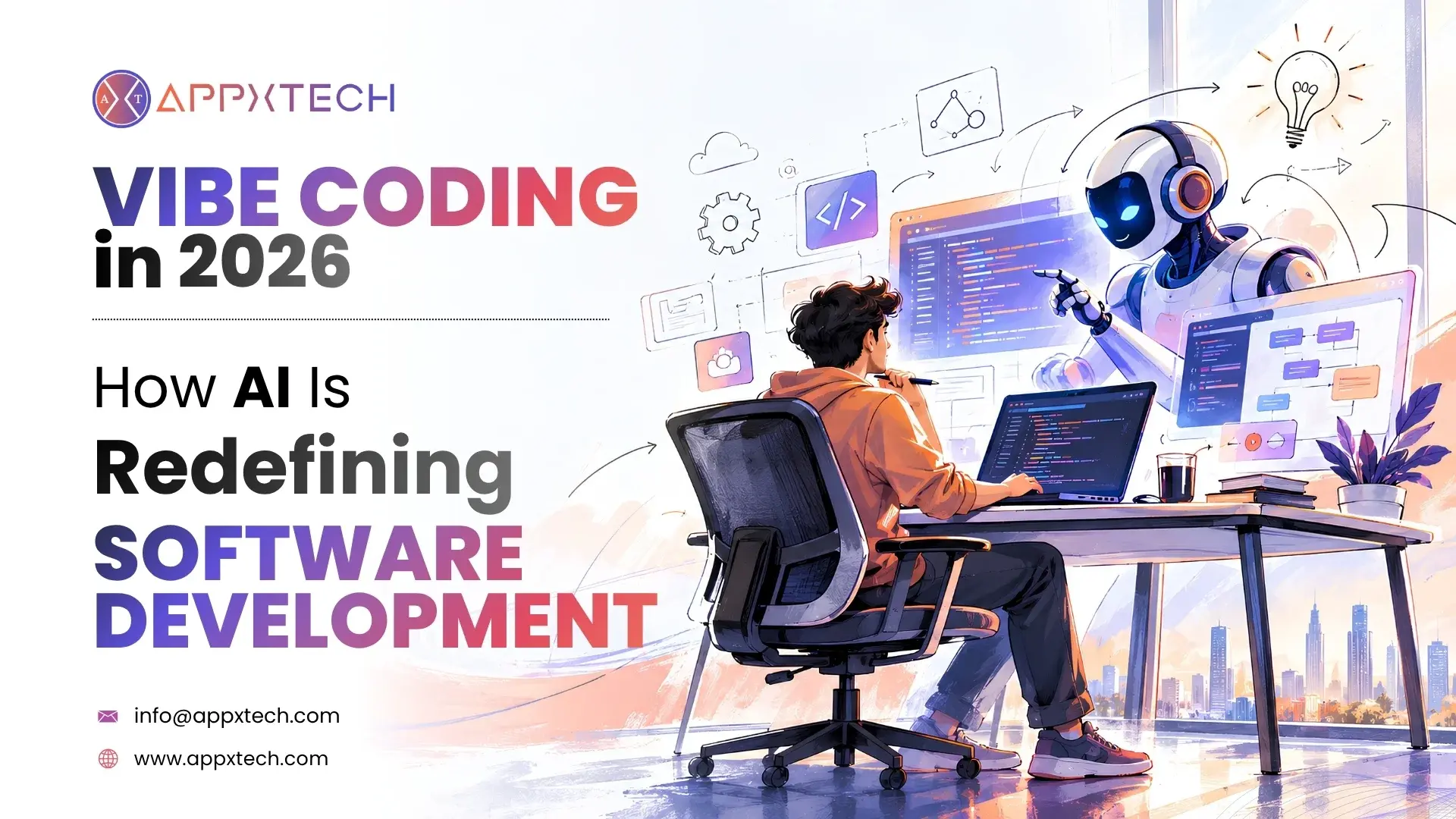
Software development is entering a new phase in 2026. Artificial intelligence is no longer limited to generating small code snippets or helping developers find bugs. It can now assist with planning, coding, testing, debugging, documentation, architecture, and even parts of deployment.
One of the most talked-about developments in this transformation is vibe coding, a way of building software where developers describe what they want in natural language and AI helps translate those ideas into working code.
But does vibe coding mean traditional programming is disappearing? Not quite. Instead, it is changing how developers think, build, and collaborate with technology.
For businesses investing in Custom Software Development, this shift creates an opportunity to develop applications faster while reducing repetitive engineering work. At the same time, organizations need experienced developers who can validate AI-generated code, protect applications, and turn AI-generated prototypes into reliable production systems.
What Is Vibe Coding?
Vibe coding is an AI-assisted development approach in which developers use natural-language instructions to communicate their requirements to an AI coding tool.
Instead of manually writing every function, a developer might describe an application feature such as:
“Create a customer dashboard that displays monthly sales, allows filtering by region, and generates an AI-powered summary.”
The AI can then generate a significant portion of the underlying code.
The developer reviews the output, identifies problems, provides additional instructions, tests the result, and continues refining the application.
In simple terms, vibe coding shifts some of the developer's work from writing code line by line to describing, reviewing, testing, and improving software.
This is particularly valuable for rapid prototyping, internal tools, proof-of-concept applications, and AI-powered products.
Why Is Vibe Coding Growing in 2026?
The biggest reason is the rapid improvement of AI coding capabilities.
Modern AI systems can understand larger amounts of context, work across multiple files, interpret existing codebases, identify errors, and generate solutions based on high-level requirements.
Several factors are accelerating adoption:
1. Faster Development
AI can generate repetitive code in seconds. Developers can spend less time creating boilerplate components and more time solving business problems.
2. Natural-Language Development
Developers can communicate requirements using everyday language instead of translating every idea into programming syntax.
3. Rapid Prototyping
Businesses can turn an early product concept into a functional prototype much faster. This helps teams test ideas before committing significant development resources.
4. Greater Developer Productivity
AI assistants can help with debugging, documentation, test generation, refactoring, and code explanations.
5. Growing Demand for AI-Powered Products
Companies increasingly want intelligent search, recommendation systems, automation, predictive analytics, conversational interfaces, and generative AI features.
As a result, AI application development is becoming an important part of modern digital product strategies.
How Vibe Coding Is Changing Custom Software Development
Traditional Custom Software Development often follows a structured process involving requirements gathering, architecture, design, development, testing, deployment, and maintenance.
Vibe coding does not necessarily eliminate this process. Instead, it changes how several stages are executed.
For example, AI can help transform business requirements into initial technical specifications. It can generate interface components, database models, API endpoints, unit tests, and documentation.
This allows development teams to move faster while maintaining human oversight.
The result is a new development model:
Business idea → AI-assisted planning → AI-generated implementation → Human review → Testing → Deployment → Continuous optimization
The human developer remains critical because software quality depends on more than generating code.
Security, scalability, system architecture, data privacy, user experience, and long-term maintainability still require expert judgment.
Vibe Coding and AI Application Development
The impact of vibe coding becomes even more significant when building AI-powered applications.
Modern applications may combine large language models, APIs, databases, retrieval systems, automation workflows, analytics, and traditional software components.
AI can assist developers in connecting these components and creating features such as:
AI-powered chatbots
Intelligent document processing
Recommendation engines
Predictive analytics dashboards
Automated customer support
AI search systems
Content generation platforms
Business process automation
For businesses exploring AI application development, vibe coding can shorten the journey from concept to prototype.
However, production-ready AI applications require more than connecting an AI model to an interface. Developers must consider model reliability, prompt design, data security, hallucinations, latency, cost, monitoring, and responsible AI practices.
Benefits of Vibe Coding for Businesses
Vibe coding can create several advantages when implemented correctly.
Faster Time to Market
AI-assisted development can reduce the time required to build and test certain features.
Lower Development Overhead
Automating repetitive coding tasks allows skilled developers to focus on higher-value engineering activities.
Faster Experimentation
Businesses can test multiple product concepts without building every version manually from scratch.
Better Collaboration
Natural-language interaction with AI can make technical concepts more accessible to product managers, designers, founders, and other stakeholders.
Easier Legacy Code Understanding
AI tools can explain unfamiliar code, summarize files, identify dependencies, and assist developers working with older systems.
Also Read :- How AI Application Development Is Transforming Modern Business Software
Vibe Coding vs Traditional Coding
Traditional coding requires developers to manually translate requirements into software.
Vibe coding introduces another layer of abstraction: developers communicate intent, and AI helps translate that intent into implementation.
The future is therefore unlikely to be simply “AI versus developers.”
It is more accurately:
Developers + AI = faster and more adaptive software development.
Developers who understand architecture, security, testing, databases, APIs, cloud infrastructure, and business requirements can use AI much more effectively than someone who relies on generated code without understanding it.
What Does the Future of Software Development Look Like?
The future of software development will likely be increasingly collaborative between humans and AI.
Developers may spend less time writing repetitive code and more time defining system behavior, reviewing AI output, designing architectures, managing data, testing applications, and solving complex business problems.
For businesses, this could mean shorter development cycles and more opportunities to experiment with digital products.
At the same time, organizations will need stronger engineering standards to ensure that speed does not come at the expense of reliability or security.
The companies that benefit most from AI will not necessarily be those that generate the most code. They will be the ones that combine AI capabilities with strong product strategy, engineering expertise, quality assurance, and business understanding.
Get in Touch with us
The Evolution of Software Development
Vibe coding represents an important evolution in software development. In 2026, AI is moving from being a developer's assistant to becoming an active participant in the development lifecycle.
For organizations investing in Custom Software Development, AI application development, and AI software development, this evolution can create significant opportunities to build, test, and improve digital products faster.
But successful AI-powered development is not simply about generating code through prompts. It requires a combination of human expertise, AI capabilities, sound engineering practices, security, testing, and business strategy.
The future belongs neither entirely to humans nor entirely to AI. It belongs to development teams that know how to combine the strengths of both.
Vibe coding is not the end of software development, it is the beginning of a more AI-assisted way of building software.
Frequently Asked Questions
What is vibe coding in software development?
Vibe coding is an AI-assisted development approach where developers describe software requirements using natural language and AI generates or modifies code based on those instructions.
Is vibe coding replacing software developers?
No. Vibe coding is changing the developer's role rather than eliminating it. Developers remain important for architecture, security, testing, code review, system integration, and complex problem-solving.
How does vibe coding help businesses?
It can accelerate prototyping, reduce repetitive development work, improve productivity, and help businesses test software ideas more quickly.
Is vibe coding useful for AI application development?
Yes. AI can help developers build interfaces, APIs, automation workflows, integrations, and other components used in modern AI applications. Human expertise is still required for production reliability, security, and performance.
What is the future of AI software development?
AI software development is moving toward intelligent applications where AI is integrated directly into business processes, customer experiences, analytics, automation, and decision-support systems.
