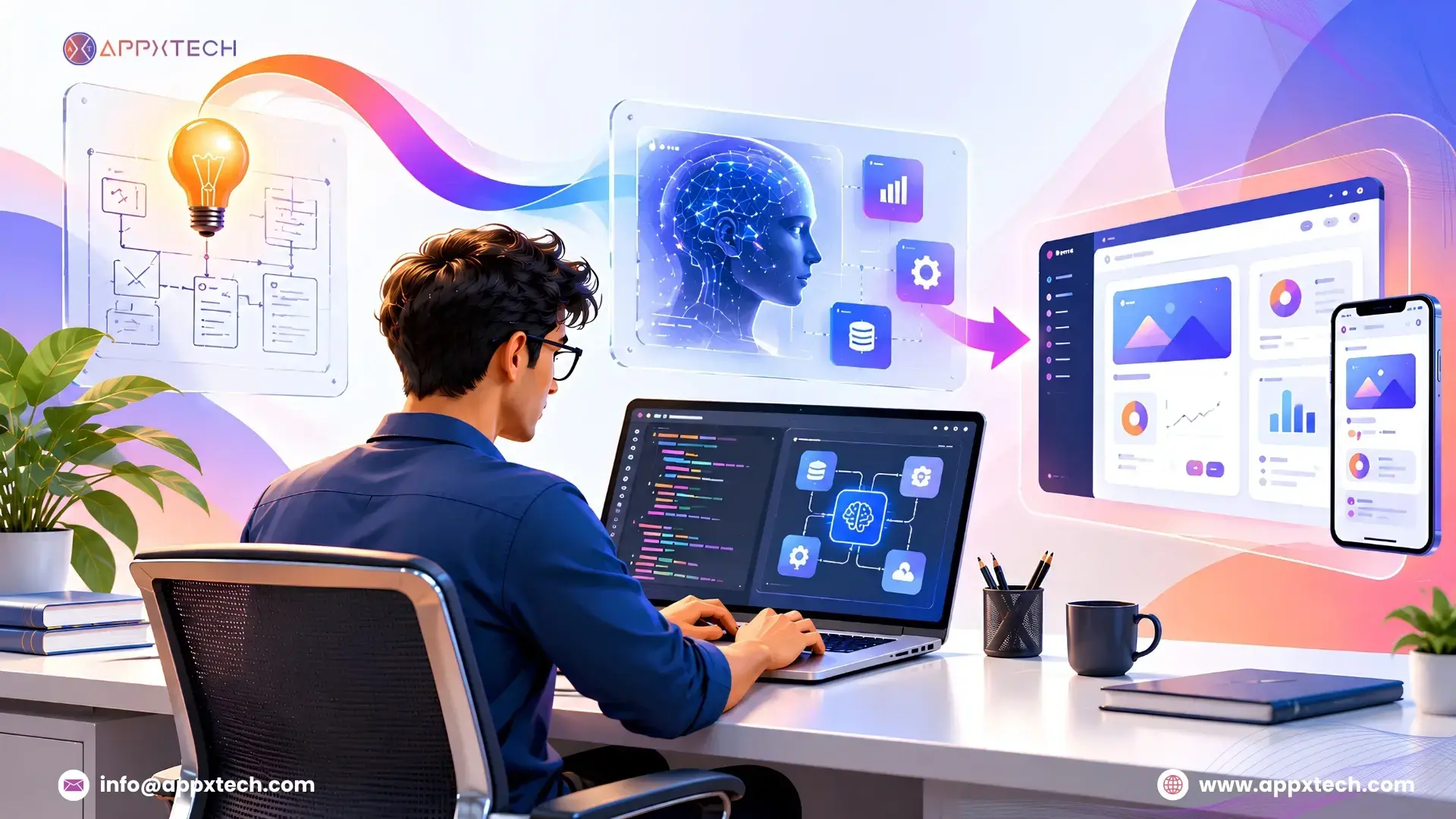
Artificial intelligence is changing how businesses operate, serve customers, and make decisions. From answering customer queries to analyzing business data, AI is helping organizations simplify complex tasks and discover new growth opportunities.
However, adopting AI is not just about adding a chatbot to a website or using a popular AI tool. Businesses need solutions that fit their goals, understand their workflows, and work smoothly with their existing systems. This is where AI application development becomes valuable.
A custom AI application can help transform a business idea into a practical digital solution, whether the goal is to improve customer experiences, automate repetitive tasks, or make faster, data-driven decisions.
In this guide, we will explore how custom AI applications work, their business benefits, the development process, and how companies can use AI automation solutions to build smarter operations in 2026.
What Is Custom AI Application Development?
Custom AI application development is the process of designing and building software that uses artificial intelligence to solve specific business problems. Unlike generic software, a custom solution is developed around an organization's requirements, data, customers, and operational processes.
Depending on the business objective, an AI application may use machine learning, natural language processing, generative AI, predictive analytics, or AI agents to perform different tasks.
For example, an e-commerce business might develop an AI application that recommends relevant products, predicts customer preferences, and answers product-related questions. A service-based company could use an intelligent application to qualify leads, schedule appointments, and respond to customer inquiries.
The main objective is simple: turn AI technology into a solution that delivers measurable business value.
Why Are Businesses Investing in AI Applications in 2026?
Businesses evaluating AI in 2026 are increasingly focused on practical use cases, integration with existing workflows, and measurable business outcomes. The focus is shifting from simply using AI to applying it where it can solve genuine business challenges. Recent industry discussions also highlight the importance of connecting AI with business workflows, data, and appropriate oversight.
Here are some key reasons behind this shift.
1. Better Operational Efficiency
Employees often spend valuable time on repetitive activities such as entering data, sorting emails, preparing reports, and responding to common questions. AI can help streamline these tasks, allowing teams to focus on work that requires creativity, judgment, and personal attention.
2. Faster, Data-Driven Decisions
Businesses generate information through sales, customer interactions, marketing campaigns, and daily operations. AI applications can analyze this information, identify patterns, and provide insights that support better planning.
3. More Personalized Customer Experiences
Modern customers expect relevant recommendations, quick responses, and convenient service. AI-powered applications can use available customer information to personalize interactions while respecting privacy and data permissions.
4. Greater Business Flexibility
A well-designed custom application can evolve alongside a business. New features, integrations, and workflows can be added as customer expectations and operational requirements change.
How AI Automation Solutions Improve Business Operations
One of the most practical uses of AI is automation. Traditional automation follows predefined rules, while AI-enabled automation can also interpret information, recognize patterns, and handle certain tasks involving unstructured data.
Effective AI automation solutions combine AI models with business rules, software integrations, security controls, and human review where necessary.
Consider a company receiving dozens of customer inquiries every day. Instead of manually reviewing every message, an AI-enabled workflow could:
Identify the customer's reason for contacting the business.
Provide an answer using approved company information.
Record relevant details in the customer relationship management (CRM) system.
Route complex requests to the appropriate employee.
Notify the team when a response or follow-up is required.
This approach reduces repetitive work without removing people from decisions that need human judgment.
Other applications include invoice processing, appointment scheduling, document classification, sales lead qualification, inventory forecasting, and internal knowledge management.
The best results often come from automating one clearly defined process before expanding into more complex workflows.
Key Benefits of AI Business Automation Services
For companies looking to improve productivity without rebuilding their entire technology infrastructure, AI business automation services can provide a structured path toward intelligent operations.
These services may include identifying automation opportunities, developing custom AI applications, integrating existing business systems, and monitoring performance after deployment.
Key benefits include:
Reduced manual effort: Automate repetitive activities so employees can spend more time on higher-value responsibilities.
Improved consistency: Standardize routine workflows and reduce errors associated with manual data entry or repetitive processing.
Faster customer support: Help customers receive timely answers and direct complex requests to the right team.
Better use of business data: Turn information stored across different systems into useful insights for planning and decision-making.
Scalable operations: Support growing workloads without relying entirely on increasing manual effort.
However, automation does not guarantee immediate cost savings or flawless results. Benefits depend on the quality of the workflow, available data, integration, and ongoing evaluation.
The Step-by-Step Process of Building a Custom AI Application
Turning an idea into a working AI application requires more than selecting a model or choosing a development framework. A clear development process helps businesses control risks, validate assumptions, and build solutions that users can trust.
Step 1: Identify the Business Problem
Start by defining the challenge you want to solve. Are customers waiting too long for responses? Is your team spending hours processing documents? Are important sales opportunities being missed?
Choose a problem that affects a measurable business outcome. A focused objective provides a stronger foundation than a vague goal such as making the business AI-powered.
Step 2: Evaluate Data and Requirements
AI applications depend on relevant, reliable information. Review the data available, its quality, access permissions, and any privacy requirements.
At this stage, define the intended users, essential features, existing software integrations, and expected outcomes. This helps determine whether a custom AI solution is necessary or whether an existing tool could meet the requirement.
Step 3: Choose the Right AI Technology
Different business problems require different approaches. Machine learning may be appropriate for forecasting, while generative AI can help summarize documents or answer questions using company knowledge.
Some applications combine several technologies with APIs, databases, and workflow automation tools. The right choice depends on the use case, budget, accuracy requirements, and security needs.
Step 4: Develop a Minimum Viable Product
Instead of building every feature at once, begin with a minimum viable product (MVP). This initial version focuses on the most important functionality and allows real users to test the solution.
For example, a customer support application might initially answer frequently asked questions before expanding to ticket classification and CRM integration.
Step 5: Test, Integrate, and Secure the Application
Test the application with realistic scenarios, including incorrect inputs, unusual requests, and situations where the AI may produce unreliable answers.
Integrate it with the necessary business systems and establish safeguards for sensitive information. Depending on the application, this may include access controls, encryption, audit logs, human approval, and clear escalation procedures.
Step 6: Deploy, Monitor, and Improve
After deployment, monitor performance using relevant metrics such as response accuracy, processing time, task completion rates, user satisfaction, and operating costs.
Collect feedback, address recurring errors, and refine the application as requirements change. AI development is an ongoing process rather than a one-time implementation.
Real-World Use Cases of AI Application Development
Custom AI applications can support businesses across different industries. Their value depends on how effectively they address industry-specific challenges.
Healthcare: Assist with appointment scheduling, administrative documentation, and patient inquiry management.
Retail and e-commerce: Personalize product recommendations, analyze demand, and automate customer support.
Real estate: Qualify property inquiries, organize listings, and help teams follow up with potential buyers.
Finance: Support document processing, transaction monitoring, and financial data analysis, subject to appropriate controls.
Logistics: Improve demand forecasting, identify delivery risks, and streamline operational planning.
These examples demonstrate how AI can support existing teams and processes. Applications involving sensitive information or high-impact decisions require additional validation, security, and human oversight.
What Should You Consider Before Developing an AI Application?
Before investing in development, consider a few essential factors.
Business objectives: Define what success looks like and how you will measure it.
Data quality: Ensure the application has access to relevant, reliable, and appropriately authorized data.
Integration requirements: Determine how the application will connect with your CRM, ERP, website, or other business systems.
Security and privacy: Establish appropriate safeguards for business and customer information.
Budget and scalability: Consider development, integration, hosting, maintenance, and ongoing AI usage costs.
User adoption: Make the application intuitive and provide training so employees understand when and how to use it.
Choosing the right development partner can also make a difference. Look for a team that understands your business processes, explains technical decisions clearly, and prioritizes measurable outcomes over unnecessary features.
Get in Touch with Us :- https://www.appxtech.com/contact
Turn Your Business Idea into an Intelligent Solution
Custom AI application development gives businesses an opportunity to move beyond generic tools and build solutions around their specific needs. From improving customer experiences to simplifying internal workflows, the right application can help teams work more efficiently and make better-informed decisions.
The most effective approach is to start small, identify a meaningful business problem, and develop a solution that can be tested and improved. As the results become clear, businesses can expand into more advanced AI automation solutions and integrated workflows.
With the right strategy, technology, and safeguards, AI can become a practical part of everyday business operations rather than just another technology investment.
If you are exploring AI business automation services, begin by identifying one repetitive task or operational challenge that consumes valuable time. That single opportunity could be the starting point for your next intelligent business solution.
Frequently asked questions
1. What is custom AI application development?
Custom AI application development involves building software tailored to business needs using AI technologies to automate tasks, analyze data, improve customer experiences, and support smarter decisions.
2. What are the benefits of AI application development for businesses?
AI application development helps businesses reduce manual work, improve operational efficiency, personalize customer experiences, analyze data, and scale operations while supporting better decision-making.
3. How do AI automation solutions improve business operations?
AI automation solutions streamline repetitive tasks, process documents, answer customer inquiries, update CRM systems, qualify leads, and route complex requests to employees for review.
4. What are the key steps in developing a custom AI application?
The process includes identifying business needs, evaluating data, selecting AI technology, building an MVP, testing security, integrating systems, deploying the application, and monitoring performance.
5. Which industries can benefit from custom AI applications?
Healthcare, retail, e-commerce, real estate, finance, and logistics can use custom AI applications to improve customer support, process documents, forecast demand, and streamline operations.
