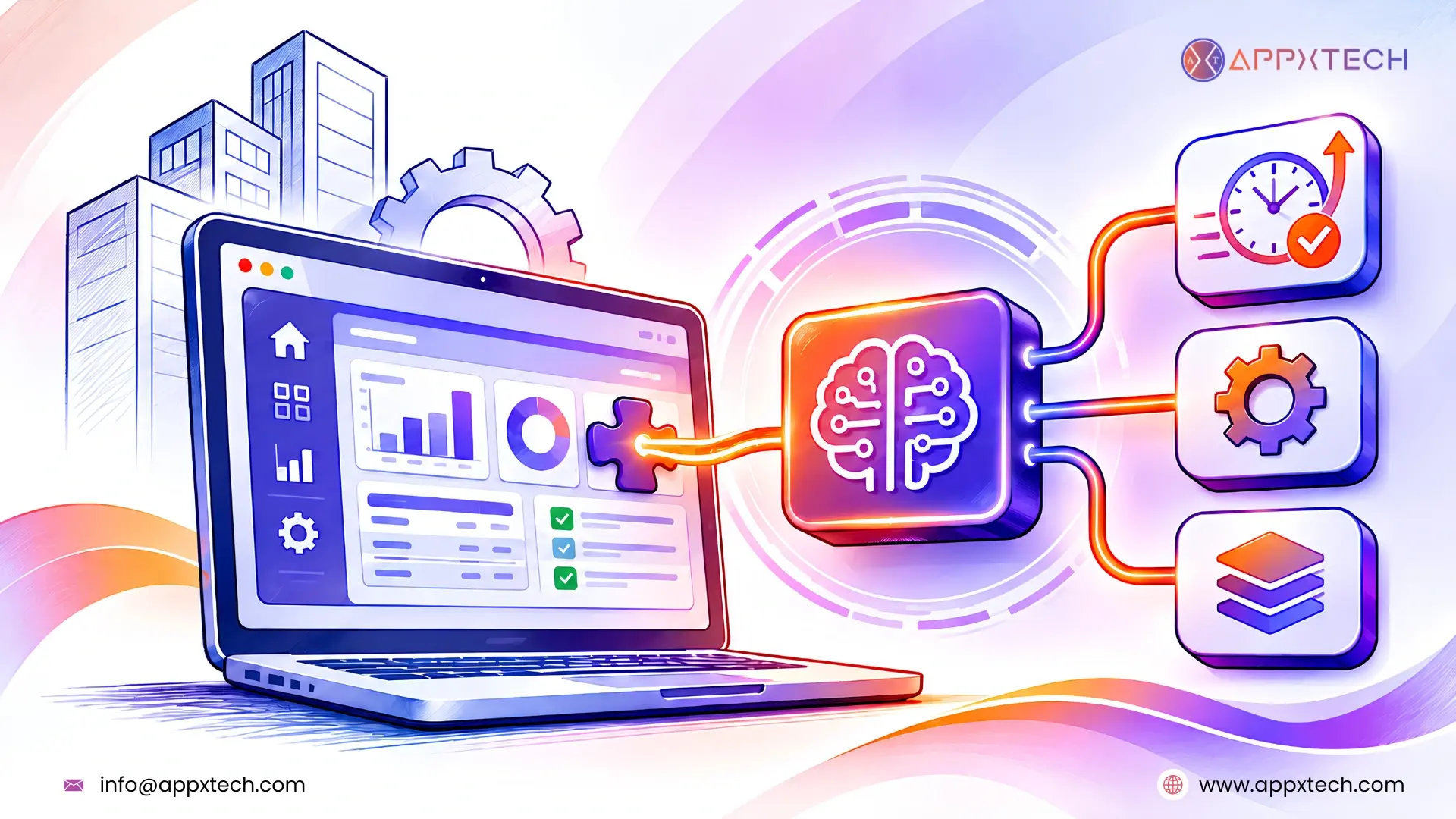
Artificial intelligence is changing how businesses manage operations, analyze data, and serve customers. From automated workflows to predictive analytics, AI offers enterprises opportunities to improve efficiency and make faster decisions. However, adopting AI does not mean businesses must replace their existing software infrastructure.
Many organizations already rely on established ERP, CRM, HRMS, and custom enterprise applications to manage daily operations. Rebuilding these systems to introduce AI can require significant investment, development time, and operational changes. A more practical approach is to integrate AI into existing enterprise software while preserving its core functionality.
With the right integration strategy, businesses can introduce intelligent capabilities through APIs, middleware, microservices, and AI models without starting software development from scratch.
Why Integrate AI into Existing Enterprise Software?
Enterprise applications contain valuable business logic, historical data, and workflows developed over years. Replacing these systems simply to adopt AI may create unnecessary complexity.
AI integration allows organizations to enhance their current applications instead of disrupting established operations.
Some important benefits include:
1. Reduced Development Costs: Businesses can extend existing applications with AI-powered features instead of investing in complete software redevelopment. This saves development time, reduces expenses, and makes better use of existing infrastructure.
2. Improved Operational Efficiency: AI can automate repetitive activities, document processing, data entry, and routine business tasks. This allows employees to focus on important responsibilities while improving overall workflow efficiency.
3. Better Decision-Making: Machine learning models can analyze large volumes of enterprise data, identify patterns, and generate useful insights. These insights help businesses make informed decisions and plan their operations more effectively.
4. Enhanced Customer Experiences: AI-powered assistants, personalized recommendations, and automated responses can improve customer interactions. Businesses can provide faster support, understand customer requirements, and deliver more relevant experiences.
5. Scalable Modernization: Organizations can introduce AI capabilities gradually according to their business requirements. This approach supports future expansion, allows new features to be added easily, and avoids replacing the entire software infrastructure.
The goal is to make existing enterprise applications more intelligent while maintaining their stability and reliability.
How Does AI Integration Work in Existing Enterprise Software?
AI integration works by connecting artificial intelligence services with existing applications through a communication layer. This layer allows enterprise systems to exchange information with AI models and receive useful outputs.
For example, an existing CRM application can connect to an AI service through an API. When a sales representative opens a customer record, the AI service can analyze available information and generate customer insights or recommendations.
Several technologies make this integration possible:
1. API-Based Integration
Application Programming Interfaces (APIs) allow existing enterprise applications to communicate with external AI services. Businesses can use AI APIs for text generation, document analysis, customer support, and predictive insights without changing the entire application architecture.
2. Middleware Integration
Middleware acts as a bridge between enterprise applications and AI services. It manages data exchange, communication, and integration between systems, particularly when organizations operate multiple applications or legacy platforms.
3. Microservices Architecture
AI functionalities can be developed as independent services and connected to existing applications. This approach allows businesses to introduce new capabilities without modifying the entire software system.
4. Retrieval-Augmented Generation (RAG)
RAG connects large language models with enterprise knowledge sources. It allows AI applications to retrieve relevant information from internal documents, databases, and knowledge repositories before generating responses.
These integration approaches help enterprises adopt AI while retaining their existing software infrastructure.
Step-by-Step Process to Integrate AI into Existing Enterprise Software
Successful enterprise AI integration requires proper planning, technical evaluation, and continuous monitoring. Businesses should follow a structured implementation process.
Step 1: Evaluate Your Existing Software Infrastructure
Start by understanding your current enterprise applications, databases, APIs, and system dependencies. Identify which applications can support direct AI integration and which may require additional integration layers.This assessment helps businesses understand technical limitations before implementation begins.
Step 2: Identify the Right AI Use Cases
Not every business process requires artificial intelligence. Focus on activities where AI can solve measurable operational problems.
Common opportunities include customer support automation, predictive analytics, intelligent document processing, workflow automation, and enterprise search.Prioritize use cases based on business value, implementation complexity, and expected outcomes.
Step 3: Prepare and Organize Enterprise Data
AI systems depend on accessible, relevant, and reliable information. Before connecting AI models, evaluate existing data sources and address issues such as inconsistent formats, duplicate records, and fragmented databases.Establish appropriate data permissions and governance policies to protect sensitive business information.
Step 4: Select the Right AI Technologies
Choose technologies according to the problem you want to solve. Large language models can support conversational applications, while machine learning models can help with forecasting, classification, and pattern recognition.
For enterprise knowledge retrieval, RAG can connect AI models with internal business information.Consider integration compatibility, scalability, security, and infrastructure requirements before selecting a solution.
Step 5: Connect AI with Existing Applications
Use APIs, middleware, or microservices to establish communication between AI services and existing enterprise applications.
For example, an ERP platform can send relevant inventory information to an AI model, which analyzes demand patterns and returns forecasting insights.The existing ERP application continues managing inventory transactions, while AI provides additional intelligence.
Step 6: Test and Deploy AI Functionality
Before production deployment, test integration performance, output accuracy, security, and compatibility with existing workflows. Start with a limited pilot project to identify potential problems. Once the solution performs reliably, gradually expand its functionality across other business processes.
Step 7: Monitor and Optimize Performance
AI integration is not a one-time activity. Monitor response accuracy, system performance, operational costs, and user feedback.Regular evaluation helps businesses identify improvements and maintain reliable AI-powered applications.
Common Challenges of Integrating AI into Legacy Enterprise Systems
Although AI integration can extend existing software capabilities, enterprises may encounter technical and operational challenges.
Legacy compatibility: Older applications may have limited APIs or outdated architectures. Middleware and API wrappers can help connect these systems with modern AI services.
Data silos: Enterprise information is often distributed across different platforms. Data integration pipelines can improve accessibility and consistency.
Security concerns: AI applications may process confidential business information. Encryption, role-based access control, and secure authentication help protect enterprise data.
AI accuracy: AI models can generate incorrect or misleading responses. RAG, output validation, and human review can reduce these risks.
Scalability: Increasing AI usage can affect infrastructure costs and performance. Scalable architecture and continuous monitoring help manage growing workloads.
Addressing these challenges during planning makes enterprise AI implementation more reliable.
Practical Use Cases of AI Integration in Enterprise Applications
AI can improve existing enterprise applications by adding intelligent features to current workflows. Businesses can automate repetitive tasks, improve data analysis, and enhance operational efficiency without rebuilding their software.
CRM Software: AI can analyze customer interactions, summarize sales conversations, identify potential leads, and recommend personalized follow-up actions to help sales teams manage customer relationships more effectively.
ERP Systems: AI can enhance ERP applications through demand forecasting, inventory optimization, financial data analysis, and automated reporting, helping businesses make better operational decisions.
HR Management Software: AI can simplify recruitment, screen applications, process employee documents, and automate routine HR queries, allowing HR teams to focus on employee engagement and strategic activities.
Customer Support Platforms: AI-powered assistants can categorize support tickets, generate response suggestions, retrieve relevant information, and automate common customer queries to improve support efficiency.
Document Management Systems: AI can extract information from invoices, contracts, reports, and other business documents, making document classification, data processing, and information retrieval faster and more accurate.
These use cases show how enterprises can introduce AI-powered capabilities into their existing applications while preserving their core architecture and established business workflows.
Best Practices for Successful Enterprise AI Integration
To achieve sustainable results, enterprises should follow a few important practices:
Begin with clearly defined business objectives.
Choose AI technologies compatible with existing infrastructure.
Maintain strong data security and governance.
Use modular architecture for easier upgrades.
Keep human oversight for critical business decisions.
Measure performance using relevant business KPIs.
Plan for ongoing maintenance and optimization.
Businesses should also evaluate whether an integration approach is sufficient or whether certain parts of their legacy infrastructure require selective modernization.
Contact Our Team to Get Started
Upgrade Existing Enterprise Software with AI
Integrating AI into existing enterprise software is a practical way to modernize business operations without rebuilding established applications. Through APIs, middleware, microservices, and RAG, organizations can introduce intelligent features while preserving their existing infrastructure and business workflows.
The most effective approach is to start with a specific business challenge, select suitable AI technologies, and implement integration gradually. With proper planning, security, and continuous optimization, enterprises can transform their existing software into more intelligent and efficient business systems without starting from scratch.
Frequently Asked Questions
1. Can AI be integrated into existing enterprise software without rebuilding it?
Yes. AI can be integrated into existing enterprise software using APIs, middleware, microservices, and AI models. These approaches add intelligent features while preserving the existing application architecture and business workflows.
2. What are the benefits of AI integration in enterprise applications?
AI integration helps businesses automate repetitive tasks, improve operational efficiency, analyze business data, support better decision-making, and enhance customer experiences without replacing their existing software.
3. Which technologies are used to integrate AI into enterprise software?
Common technologies include AI APIs, large language models (LLMs), machine learning models, middleware, microservices, and Retrieval-Augmented Generation (RAG). The right choice depends on business requirements and existing system architecture.
4. Can AI be integrated into legacy enterprise systems?
Yes. Legacy systems can connect with AI services through API wrappers, middleware, and data integration pipelines. These methods help bridge compatibility gaps while minimizing changes to existing infrastructure.
5. How does custom enterprise application development support AI integration?
Custom enterprise application development helps businesses build and extend software around their specific workflows. AI capabilities can be added to these applications through APIs and modular services, making it easier to automate processes and improve functionality without rebuilding the entire system.
