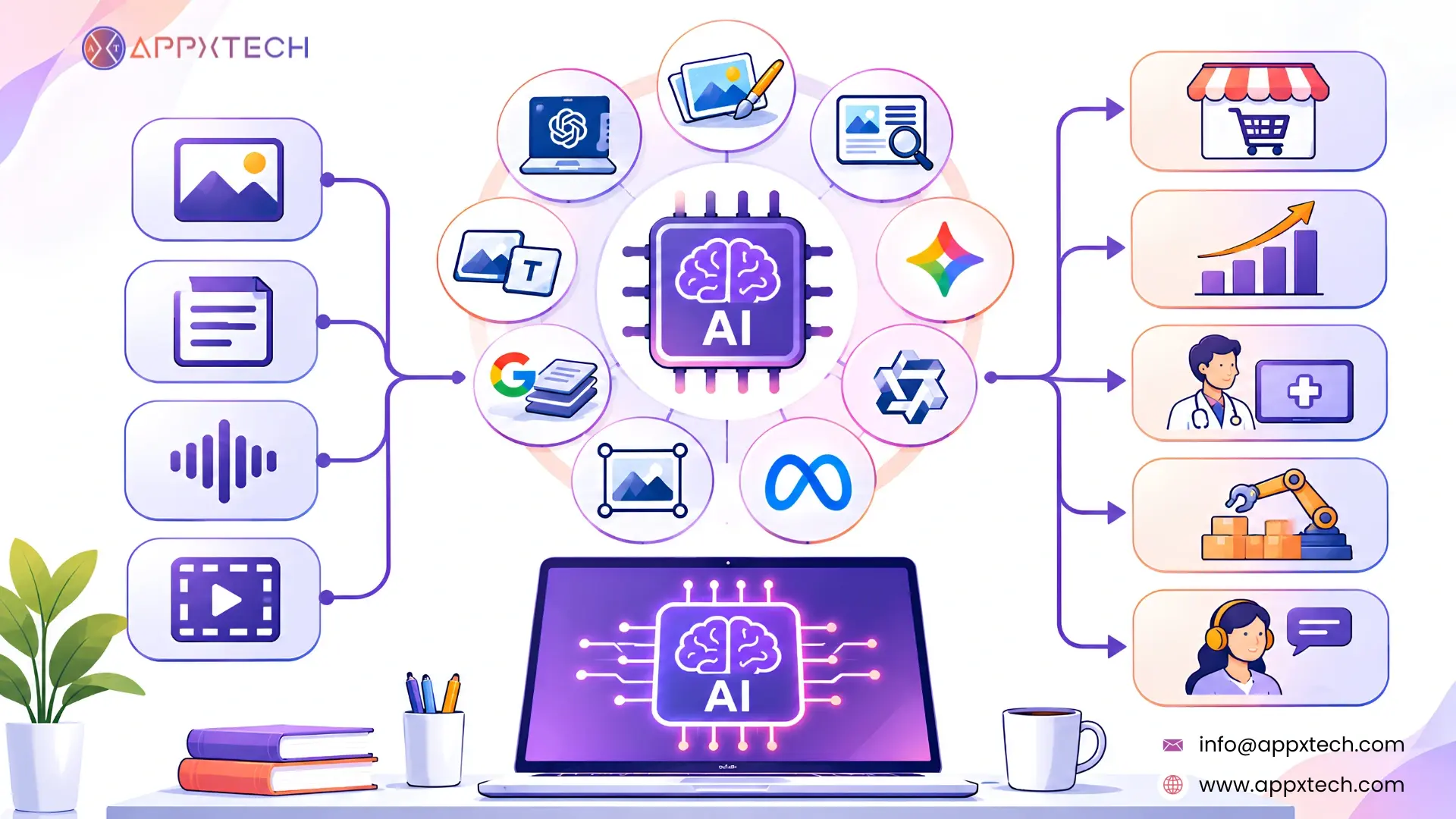
Businesses generate enormous amounts of information every day, including customer conversations, images, videos, documents, audio recordings, and sensor data. However, analyzing these different formats separately can make it difficult to identify meaningful insights and automate complex processes. This is where multimodal artificial intelligence (AI) is changing how organizations operate.
Multimodal AI enables machines to understand and process multiple types of data together, helping businesses make informed decisions, improve customer experiences, and streamline operations. From intelligent customer support to automated quality inspection, its applications are expanding across industries.
By investing in AI application development organizations can integrate multimodal capabilities into existing systems or build custom AI-powered solutions to address specific operational challenges. Let's explore what multimodal AI is and 10 practical applications that demonstrate its growing potential in business.
What Is Multimodal AI and How Does It Work?
Multimodal AI is a type of artificial intelligence that processes and interprets multiple data formats, such as text, images, audio, video, and sensor information. Unlike traditional AI systems designed for specific data types, multimodal systems can combine information from different sources to understand context and generate more relevant outputs.
For example, an AI-powered customer support system can analyze a customer's written complaint, listen to a voice recording, and examine an uploaded product image to understand the issue more comprehensively.
How Does Multimodal AI Work?
Multimodal AI works by combining information from different data formats, such as text, images, audio, video, and sensor data. It uses deep learning techniques and AI models to process these inputs, identify relationships, understand context, and generate meaningful outputs. The process generally involves the following six steps:
1. Data Collection and Preprocessing
The first step involves collecting data from multiple sources, including text documents, images, audio recordings, videos, and IoT sensors. The collected data is then cleaned, organized, and converted into suitable formats to remove unnecessary information and improve processing quality.
2. Feature Extraction
Once the data is prepared, AI models extract important features from each data type. For example, computer vision models identify objects and patterns in images, while Natural Language Processing (NLP) models understand words, sentences, and their meanings. Audio models identify speech patterns and relevant sound information.
3. Data Fusion
In this stage, information extracted from different modalities is combined to create a unified understanding. Multimodal AI uses techniques such as early fusion, late fusion, and hybrid fusion to connect information from different sources and identify relationships between them.
4. Model Training and Processing
The combined information is processed through multimodal AI architectures, such as transformers and deep learning models. These models learn from different data types and develop the ability to interpret information across modalities, depending on their training and design.
5. Cross-Modal Learning
Cross-modal learning enables AI models to understand relationships between different data formats. For example, a system can connect spoken instructions with corresponding images or identify relationships between facial expressions and textual sentiment. This helps the model develop a deeper understanding of combined information.
6. Decision-Making and Output Generation
In the final stage, the AI system uses its understanding to perform tasks such as classification, prediction, recommendation, question answering, or content generation. Depending on the application, it can generate responses, provide insights, or trigger automated business actions.
By combining different information sources, multimodal AI can support business processes that require more context than a single data format can provide.
10 Real-World Multimodal AI Applications in Business
Multimodal AI is becoming relevant across industries because business decisions often depend on information available in different formats. Here are 10 important applications.
1. Intelligent Customer Support and Virtual Assistants
Customer support teams handle queries through emails, phone calls, live chats, screenshots, and product videos. Managing these channels separately can slow down issue resolution.
Multimodal AI can analyze written messages, voice recordings, and visual evidence to understand customer problems. For instance, a customer experiencing a product malfunction could upload a short video and describe the issue. An AI assistant can examine the visual information and written explanation before suggesting troubleshooting steps.
Businesses can use this capability to automate ticket classification, provide contextual responses, and assist support representatives.
Business benefits: Faster issue resolution, reduced manual workload, consistent customer support, and improved customer experiences.
2. Healthcare Diagnostics and Medical Imaging
Healthcare professionals work with different information sources, including medical images, clinical notes, laboratory reports, and patient records. Multimodal AI can help analyze these sources together to provide additional context for clinical workflows.
For example, an AI system can examine medical imaging alongside relevant clinical documentation to highlight findings that require further professional review. It can also assist with organizing medical records and extracting information from reports.
These applications are intended to support healthcare professionals rather than replace clinical judgment or independent diagnosis.
Business benefits: More efficient documentation, improved information accessibility, and better-supported clinical workflows.
3. Retail and E-commerce: Visual Product Search
Traditional product searches often depend on customers knowing the correct product name or keywords. Multimodal AI makes product discovery more flexible by combining images, text descriptions, and customer preferences.
For example, shoppers can upload a photograph of a furniture item and ask an AI shopping assistant to find similar products. The system can analyze visual characteristics such as color, shape, and design before displaying relevant results.
Retailers can also combine browsing behavior and product information to deliver personalized recommendations.
Business benefits: Improved product discovery, personalized shopping experiences, and more relevant recommendations.
4. Manufacturing: Quality Inspection and Predictive Maintenance
Manufacturing facilities generate visual and operational data through production cameras, machine sensors, and equipment monitoring systems. Multimodal AI can combine these sources to support quality inspection and equipment maintenance.
For example, computer vision can identify visible product defects while sensor data helps detect unusual machine vibration or temperature changes. Combining these signals can help maintenance teams investigate potential equipment problems.
AI-powered inspection systems can also flag products that require human verification.
Business benefits: Improved quality control, reduced manual inspection, better equipment monitoring, and fewer unexpected production interruptions.
5. Banking and Finance: Fraud Detection and Risk Assessment
Financial institutions process large volumes of transaction records, identity documents, invoices, and customer activity data. Analyzing these sources together can help identify suspicious patterns.
Multimodal AI can compare information from identity documents with transaction details and other relevant signals. For example, a financial institution could use document analysis and behavioral information to flag inconsistencies for additional verification.
These systems can support fraud investigation, compliance workflows, and risk monitoring, with human oversight for important decisions.
Business benefits: More efficient fraud investigation, improved document verification, and stronger risk monitoring.
6. Autonomous Vehicles and Intelligent Transportation
Autonomous transportation systems rely on information from cameras, radar, LiDAR, GPS, and other sensors to understand their surroundings.
Multimodal AI can combine these inputs to identify nearby vehicles, pedestrians, road signs, traffic conditions, and potential obstacles. This contextual understanding helps autonomous systems interpret their environment and support navigation decisions.
Similar technologies can also assist transportation companies with traffic monitoring and fleet management.
Business benefits: Improved environmental awareness, smarter transportation management, and support for safer navigation systems.
7. Education: Personalized Learning Experiences
Educational institutions use different learning formats, including textbooks, recorded lectures, diagrams, presentations, and interactive lessons. Multimodal AI can bring these resources together to create more engaging learning experiences.
For instance, an AI learning assistant can explain a scientific diagram, summarize a recorded lecture, and answer questions using related course materials. It can also help educators create quizzes and learning resources based on existing content.
This allows educational platforms to support different learning preferences while reducing repetitive administrative tasks.
Business benefits: Personalized learning support, improved content accessibility, and more efficient educational workflows.
8. Logistics and Supply Chain Management
Logistics operations depend on shipment documents, warehouse images, GPS information, inventory records, and sensor data. Multimodal AI can analyze these inputs to improve operational visibility.
For example, a warehouse management system can examine product images alongside inventory records to identify possible discrepancies. Shipment documents and tracking information can also be processed together to support delivery monitoring.
When connected with enterprise systems, AI can flag delays, organize shipment information, and help employees prioritize operational issues.
Business benefits: Better inventory visibility, improved shipment monitoring, and streamlined supply chain operations.
9. Insurance: Automated Claims Processing
Insurance companies regularly receive claim forms, photographs, videos, repair estimates, and supporting documents. Reviewing these materials manually can make claims processing time-consuming.
Multimodal AI can extract information from documents, examine damage photographs, and compare the findings with relevant policy details. For example, vehicle damage images and repair estimates can be analyzed together to support an initial claims assessment.
Claims requiring additional investigation can be forwarded to human adjusters rather than being automatically approved or rejected.
Business benefits: Reduced document processing effort, faster preliminary assessments, and more organized claims workflows.
10. Marketing and Media: AI-Powered Content Creation
Marketing teams work with written content, product images, promotional videos, voice recordings, and customer engagement data. Multimodal AI can help coordinate these different content formats.
For example, marketers can use product information and images to generate initial campaign copy, create video descriptions, or adapt content for different platforms. AI can also analyze visual and textual engagement signals to help teams understand audience preferences.
Human review remains important for brand consistency, factual accuracy, and creative quality.
Business benefits: Faster content workflows, improved personalization, and more efficient campaign production.
The right multimodal AI model depends on the business application, supported data formats, accuracy requirements, deployment preferences, security, and development costs. Organizations should evaluate models against their actual workflows before selecting a solution.
Key Business Benefits of Multimodal AI
Beyond individual applications, multimodal AI offers several opportunities for organizations:
Better decision-making: Combining information from multiple sources provides additional context for business analysis.
Improved operational efficiency: AI can automate repetitive activities involving documents, images, audio, and other data.
Enhanced customer experiences: Businesses can respond to customer needs using information gathered across different communication channels.
Greater process visibility: Organizations can identify patterns and discrepancies that may be difficult to detect when data is analyzed separately.
Scalable automation: Multimodal capabilities can be integrated into enterprise applications and workflows as business requirements evolve.
However, these benefits depend on data quality, model performance, integration, and appropriate human oversight.
How Can Businesses Implement Multimodal AI Solutions?
Successful implementation requires more than selecting an AI model. Businesses should follow a structured approach.
Identify business requirements: Select workflows where information from multiple data formats is important. Define measurable objectives before development.
Choose suitable AI technologies: Evaluate multimodal foundation models, computer vision, natural language processing, and speech recognition based on the use case.
Prepare and integrate data: Connect relevant business applications, databases, documents, APIs, and devices while maintaining data quality and security.
Develop custom AI applications: Build solutions that integrate AI capabilities with existing enterprise software and business processes.
Test and optimize: Evaluate accuracy, response time, cost, and reliability. Introduce human review for sensitive or high-impact decisions.
Businesses should also consider privacy, access controls, data governance, and ongoing model monitoring throughout implementation.
How AI Business Automation Services Help Businesses Adopt Multimodal AI
Implementing multimodal AI can require expertise in model selection, data engineering, software integration, and workflow design. This is where professional AI business automation services can help organizations identify suitable opportunities and develop practical solutions.
Through custom AI application development, businesses can integrate multimodal capabilities into customer support platforms, enterprise applications, document management systems, and operational workflows.
An Intelligent Automation service can further combine AI, machine learning, computer vision, and workflow orchestration to reduce repetitive work and improve process efficiency.
Working with an experienced AI development partner helps businesses align technology choices with operational requirements, security considerations, and long-term scalability.
Future Trends of Multimodal AI in Business
Multimodal AI is expected to evolve through several emerging capabilities:
1. Advanced Multimodal Data Fusion
Future multimodal AI models will use advanced data fusion techniques to combine and interpret information from different sources more effectively. By dynamically connecting text, images, audio, and sensor data, these systems will deliver more accurate insights and support smarter decision-making in complex business environments.
2. Emotionally Intelligent AI Systems
Multimodal AI is expected to become better at recognizing emotional signals by analyzing voice tone, facial expressions, text patterns, and other contextual cues. This could help businesses develop more empathetic virtual assistants, improve customer interactions, and create personalized digital experiences. However, emotion detection will require careful attention to privacy, consent, and accuracy.
3. Real-Time Multimodal Interactions
Advancements in edge computing and AI processing will enable faster interactions across text, speech, images, and video. Businesses will be able to use these capabilities to deliver context-aware responses with reduced delays. For example, customer support platforms could understand voice queries and visual inputs simultaneously, while healthcare applications could assist professionals in analyzing information more efficiently.
4. Cross-Modal Learning and Knowledge Transfer
Future AI models will increasingly learn relationships between different data types and use knowledge from one modality to perform tasks involving another. For instance, an AI system could generate text descriptions from images, create summaries of video content, or connect spoken instructions with visual information. This capability will make AI applications more flexible and useful across business operations.
5. Multilingual and Multimodal Integration
The combination of multilingual AI capabilities and multimodal processing will make business applications more accessible across languages and communication formats. AI systems will be able to understand and process different languages alongside text, speech, images, and video. This can support multilingual customer service, real-time translation, content summarization, and communication with customers across global markets.
These developments create new opportunities, but their business value will depend on reliability, security, cost, and measurable outcomes.
Build with Appxtech
Driving Business Innovation with Multimodal AI
Multimodal AI is creating new ways for businesses to understand information, automate workflows, and improve decision-making. From healthcare and manufacturing to retail, finance, and logistics, its applications demonstrate how combining different data formats can address complex business challenges.
However, successful adoption requires selecting the right use cases, preparing reliable data, and integrating AI into existing operations responsibly.
Businesses looking to move beyond traditional automation can explore custom AI solutions that align with their goals. With the right AI development and automation strategy, multimodal AI can become a valuable part of long-term digital transformation.
Frequently Asked Questions
1. What are the applications of multimodal AI in business?
Multimodal AI is used in customer support, healthcare, retail, manufacturing, banking, logistics, education, insurance, transportation, and marketing. It helps businesses analyze different data formats together to improve workflows, decision-making, and customer experiences.
2. How does multimodal AI improve business automation?
Multimodal AI improves automation by processing information from documents, images, audio, videos, and sensors together. This helps businesses automate tasks such as document processing, customer query handling, quality inspection, and claims assessment.
3. What is the difference between multimodal AI and generative AI?
Multimodal AI focuses on understanding or generating information across multiple data formats. Generative AI focuses on creating new content, such as text, images, audio, or video. These capabilities can overlap in modern AI systems.
4. Which industries benefit most from multimodal AI?
Healthcare, manufacturing, banking, retail, insurance, education, logistics, and transportation can benefit significantly because their operations involve information from multiple data sources.
5. Can multimodal AI automate complex business processes?
Yes. When integrated with enterprise applications, APIs, and workflow automation tools, multimodal AI can support complex processes involving document analysis, visual inspection, customer interactions, and data-driven decisions. Human supervision remains important for sensitive tasks.
